Share
Online Color Analysis | SAVE $50
Couldn't load pickup availability

Discover Your True Color Harmony & See Yourself in 900+ Colors
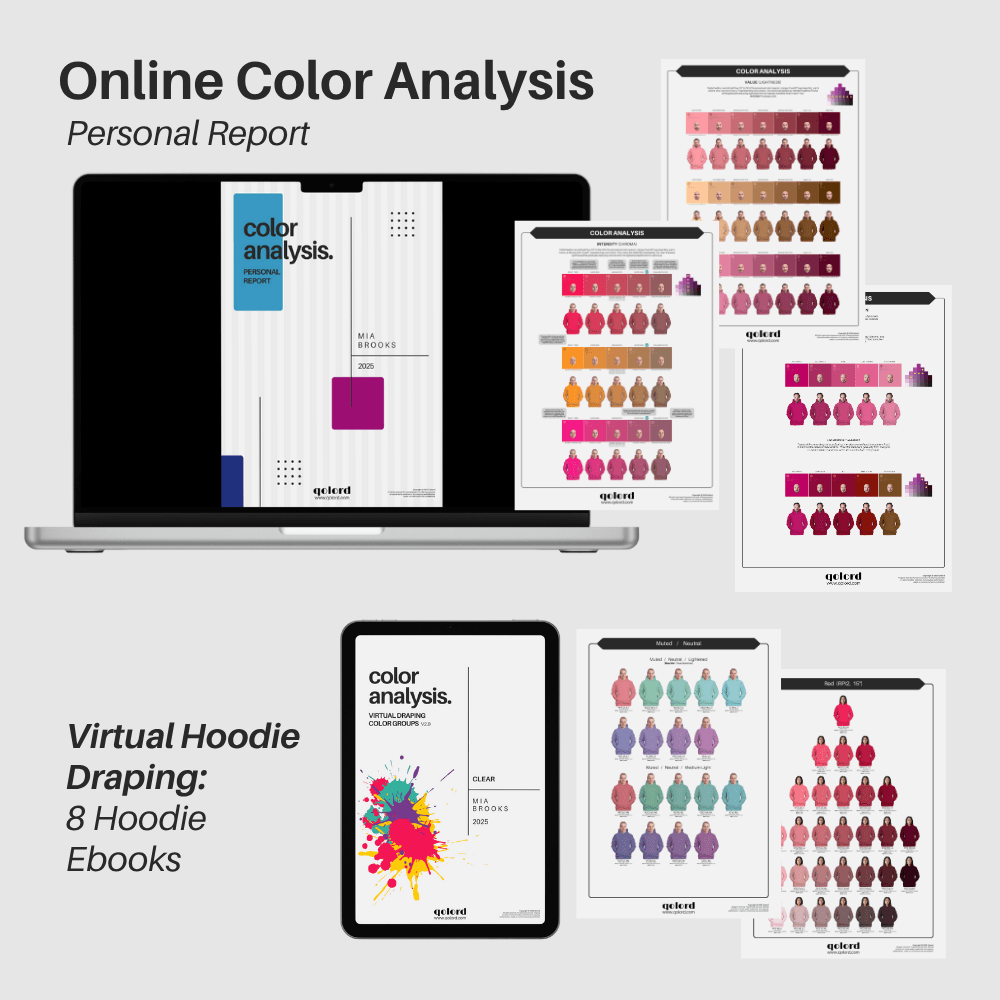
Discover which colors truly flatter you with Qolord's original 30+ page Online Color Analysis Report that goes beyond traditional seasonal tests.
With Qolord's smart virtual draping you’ll be guided through multiple tests measuring intensity (chroma), value (lightness), hue, and seasonal fit.
Additionally, you will be virtually draped in 900+ colors across the full spectrum of color wheel, revealing the color tones that make you shine through 6 exclusive personalized hoodie draping e-books.
Why Color Analysis
Color analysis has made a big comeback since its original rise in the 70s and 80s, drawing in a new wave of people curious to discover “their colors.” And yet, many still haven’t heard of it. But even without knowing the term, most of us have noticed: some colors make a person glow, others make them fade.
At its core, color analysis is about finding colors that align with your natural coloring—your skin, eyes, lips, and sometimes hair. It asks: which colors support what’s already there, rather than compete with it? And there are many methodologies to achieve it. Let's explore!
What Makes Qolord Different?
The seasonal system is the most well-known color analysis system, and has helped millions find direction. Other color analysis systems focus on custom palettes, neutrals, or matching colors to pigments in your features (eyes, lips, hair). Each seeks harmony, but not all define what it is in the same way.
-
How Qolord Started
It all started when I got my Cool Summer palette. I stared at those 40 colors thinking—out of 1 million visible color tones, are these really the only ones I’m supposed to wear? Some looked almost identical. Others felt so random, I couldn’t figure out how they made it into my palette. The accents were too bright, and overall I couldn’t see any consistency in the hues—where the colors sat on the color wheel.
And don’t even get me started on shopping. Even basic T-shirts in the “right” shades were nearly impossible to find. That’s when the idea hit: what if I made a streetwear shop with as many colors as I can—especially the ones no one’s putting on the shelves?
-
When the Theory Didn’t Add Up
As I started developing this dream, I thought I’d map the colorful clothes to the seasonal analysis system. But the deeper I went, the more confusing it got. Every color analysis system had its own logic, and their palettes looked quite different—even when they were supposedly based on the same theories. I tried multiple times to figure out the logic behind which colors fit which season, but never found a clear answer.
So I decided to start again. From scratch.
-
Finding Your Harmony Through the Science of Color
I turned to the science of color itself—focusing on chroma (intensity), lightness (value), and hue (color family around the wheel, like red, yellow, or green). These characteristics exist in every color we see. And when it comes to people, our skin, lips, eyes, and even hair all carry their own unique mix of those traits.
Together, they blend into a kind of color harmony. That harmony can be muted and low-contrast, or bright and high-contrast. It can be warm or cool, light or deep. The goal of color analysis is to find your harmony—and pinpoint where it sits on the color wheel.
-
How Online Color Analysis Works
Traditional color analysis is done in person, with physical drapes. And yes, in-person gives you a fuller sensory picture. But with today’s tech, we can translate real-world color into virtual space—if the process is structured and precise—making online color analysis not only possible, but reliable.
If a photo is taken carefully (good light, no filters, no color distortion, white balance correction), a well-built virtual system can get consistent results. It’s not magic. It’s mapping harmony using consistent visual logic.
-
Organizing the Color Wheel into Color Groups
I spent last years observing already-analyzed people from the 16-season system. I experimented with structuring color wheel in different ways to create color groups. Too many colors can feel overwhelming and impractical when differences between them are hard to distinguish—too few color groups, and some people’s best colors get left out.
Eventually, I landed on a system of 933 colors, divided into multiple color groups. Each one mapped by shared properties or color characteristics.
What You'll Get with Your Online Color Analysis
That’s what Qolord is: a smart, structured, and fresh approach to virtual color analysis. It’s built around a series of unique tests designed to guide you toward your most harmonious colors. You can get one or all of these color analysis resources:
- Online Color Analysis Report
- 5 Color Group Hoodie E-books
- 1 Full Hue Hoodie E-book
Ready to see what that looks like in action? Let’s break down the tests you’ll get after purchasing your online color analysis.
Part 1
Quick Theory
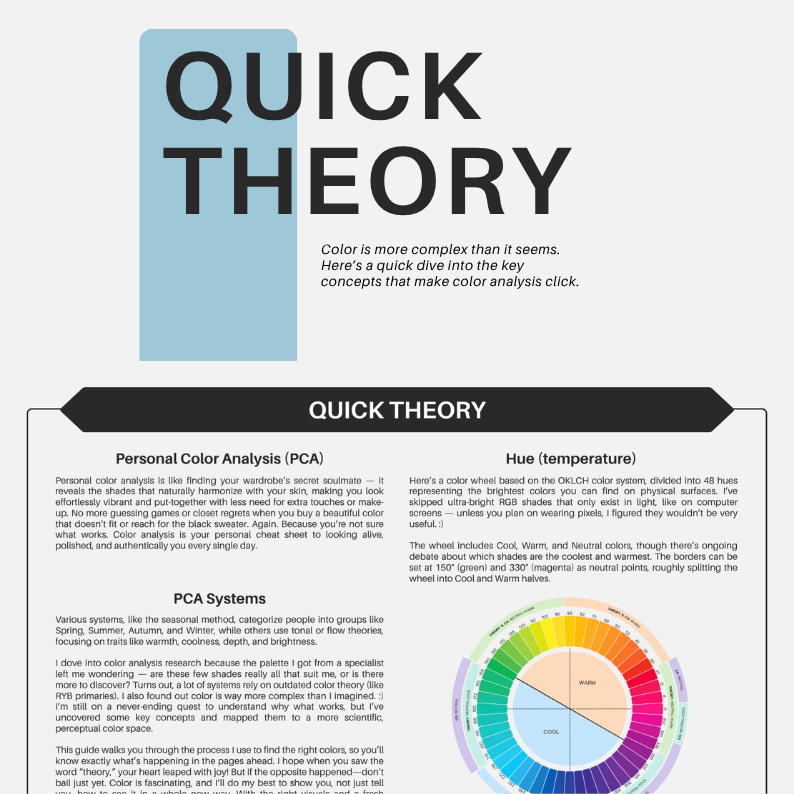
Before your analysis, you'll get a compact, visually-rich 3-page introduction to the Qolord color system. It gives you a clear understanding of how the system works, what influences your color harmony, and how to interpret your results. You'll see how the color groups are built, how colors are organized in the system, and the essential color theory behind it — designed to help you make sense of your palette.
You won’t just receive color palettes—you’ll gain insight into why these colors work for you. I want to share knowledge that stays with you for life, not just deliver quick results.
Part 2
Skin Tone Analysis
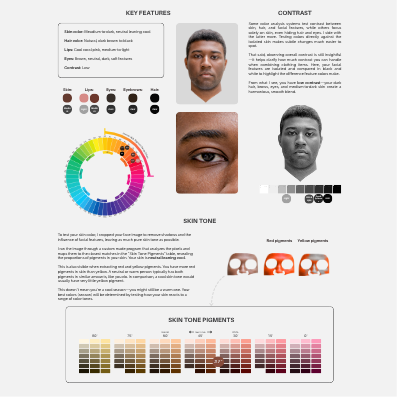
Skin, eyes, lips, and hair all give valuable clues—but analyzing just a few pixels isn’t enough to define your colors or season. I’ll look at your feature colors and how they sit on the color wheel, the contrast between your features, and the proportion of red or yellow pigments.
Your edited face pigments are also run through a program that calculates the average—so you can see a clear visual of how warm or cool your skin tone appears. While this isn’t an exact science (digital images aren’t perfect), it gives a strong sense of direction. If your skin is very warm, for example, that warmth usually comes through clearly—even if there’s a slight shift or inaccuracy in white balance adjustment.
Part 3
Intensity (Chroma) Test
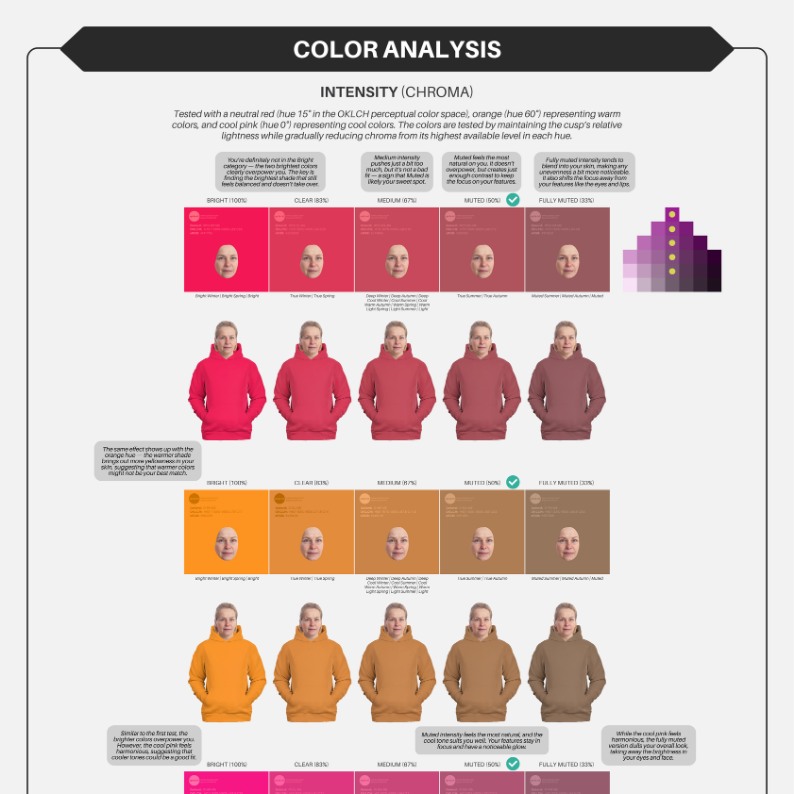
I start with an intensity (chroma) test. While most analyses begin by comparing warm and cool tones, I find that chroma—whether you lean bright, medium, or muted—offers a faster, clearer insight into your natural harmony. It creates a solid foundation to understand your characteristics. Chroma is also the easiest quality to spot visually. Checking temperature or value in the wrong brightness can be misleading, so we begin with intensity first. After that, we explore colors close to your identified chroma level.
All tests are done using both color rectangles with only your face and virtually draped hoodies. The intensity test includes colors across different temperatures to give you a broader impression right from the start.
Part 4
Value (Lightness) Test
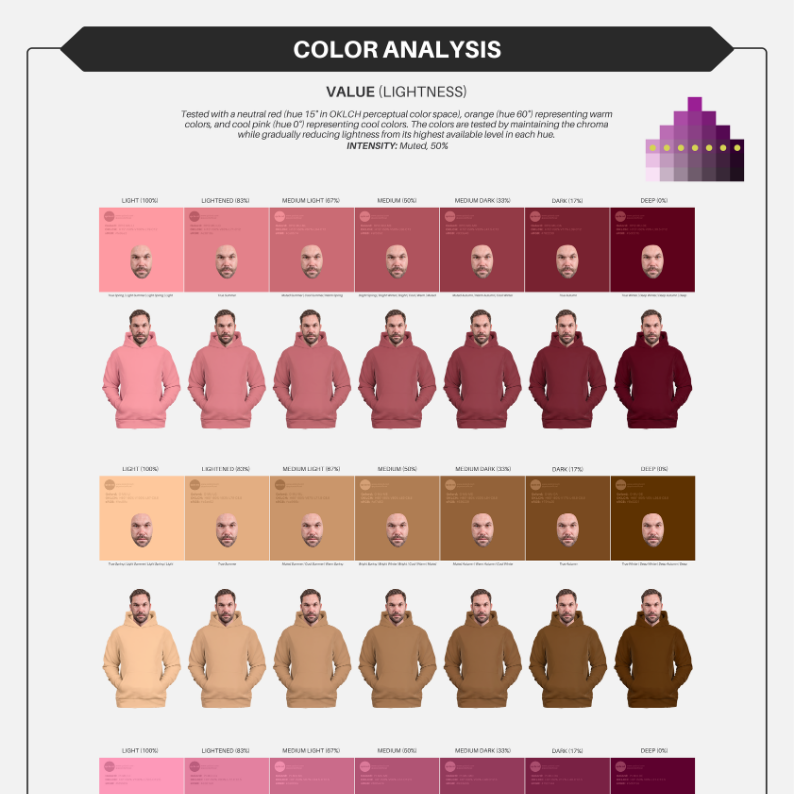
Once I determine the intensity that suits you best, I move on to value (lightness) testing. This is done using colors in the exact same intensity, because lightness can look very different depending on chroma—both in contrast and overall impression.
Here, we figure out whether you lean more light, deep, or somewhere in between. Sometimes it's obvious—light shades can wash you out or feel clownish, while deep tones may overwhelm you. Other times, both extremes feel off, pointing to a more balanced value range. This step offers more clarity about your unique color characteristics.
Part 5
Absolute Lightness Test
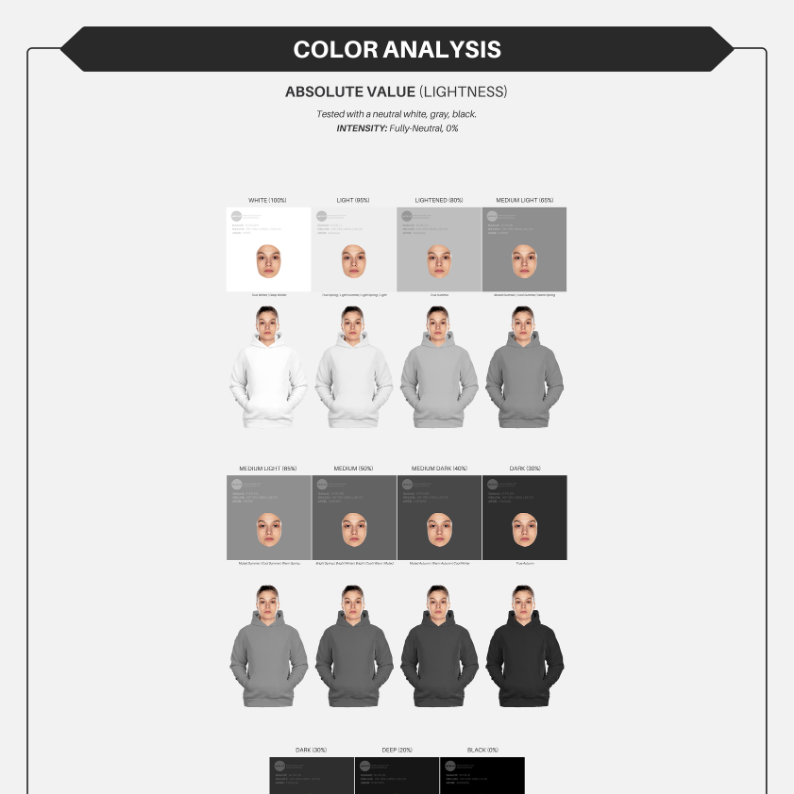
Through extensive testing, I developed a color system where each hue is structured relative to the others. It’s a complex structure, but here’s what matters for your analysis: absolute lightness can appear very different depending on the hue. For instance, the same lightness value might look pastel in indigo blue but muddy and dark in lemon yellow.
Still, absolute lightness is a helpful tool—it reveals which lightness range suits you best. Once your ideal lightness range is identified, it becomes much easier to navigate various hues and find tones that truly work for you.
Part 6
Temperature (Hue) Test
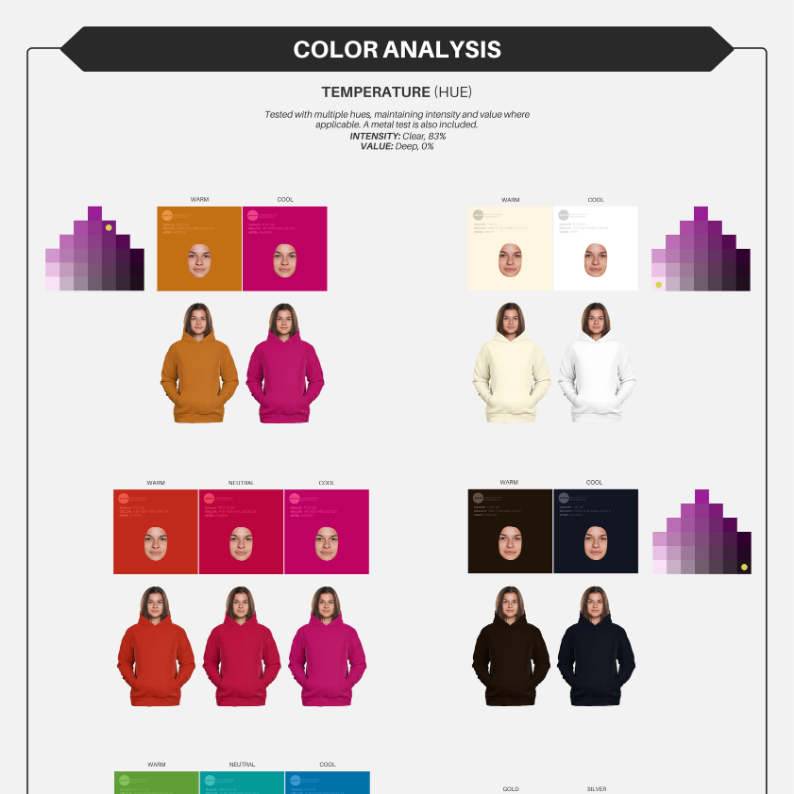
Now that intensity and value have been established, we move on to testing temperature (hue). The colors used here are selected to match the chroma and value revealed in earlier steps. This test shows whether very warm oranges, very cool pinks, or more neutral tones suit you best. If both warm and cool tones feel off, it’s likely you wear more neutral colors well.
This stage offers an initial insight into your temperature—whether you lean warm, cool, or sit in the middle. Later, we’ll test a wide range of hues independently of temperature to refine the picture even further.
Part 7
Seasonal Comparison
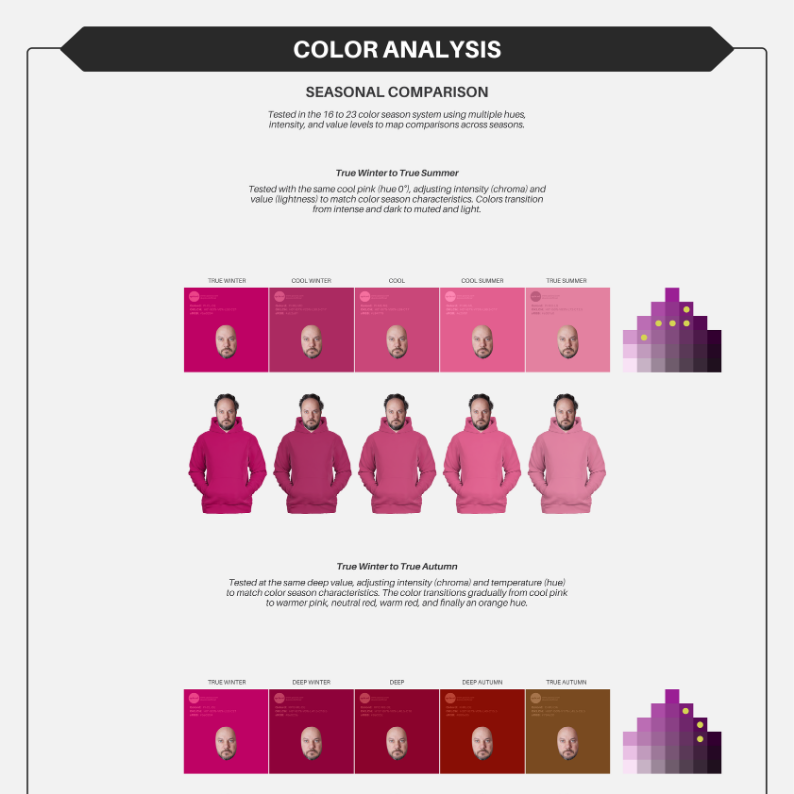
Now that the individual tests are complete, we go even deeper. This stage brings together color tones that vary in chroma, lightness, and temperature. I've curated tones that represent each seasonal flow, such as all cool seasons spanning from True Winter to True Summer, including Cool Winter and Cool Summer in between, or deep tones from True Winter to True Autumn with Deep Winter and Deep Autumn in between.
This step also acts as a cross-check, helping confirm whether all previous test results align. It’s also where lingering uncertainty between two or three color groups often becomes clear.
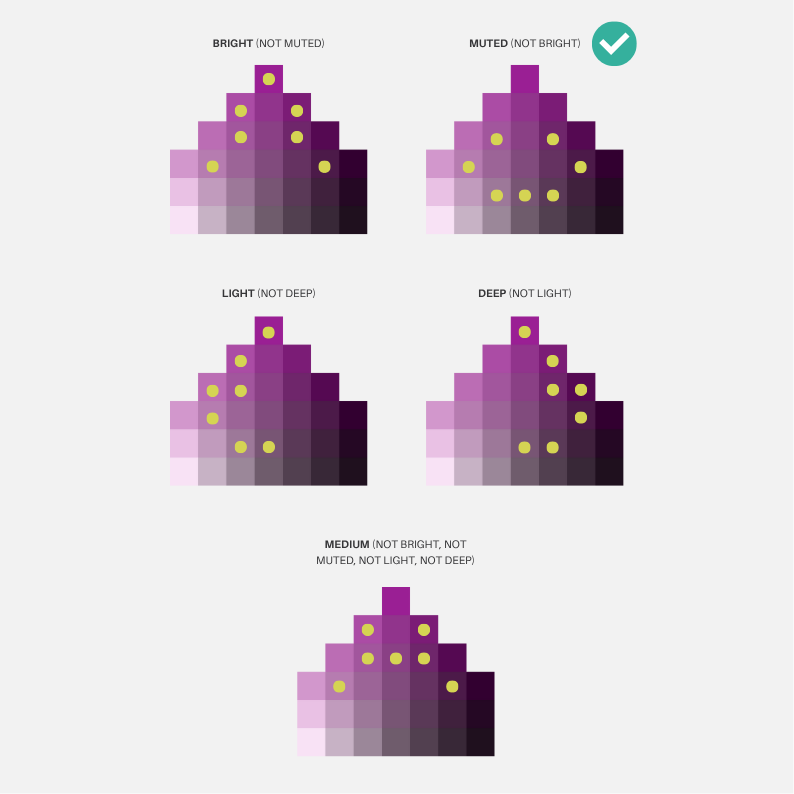
Part 8
Closest Color Comparison Across 24 Hues Around the Color Wheel
From the previous tests, we’ve gained a clear sense of which color groups might suit you—and which definitely don’t. For each person, it’s usually clear if they are definitely not muted—in that case, we focus on bright to medium groups. Or if they are clearly not bright, we test muted to medium groups instead. The same goes for light or deep. If none of these extremes fit, we explore all the medium groups to find the best match.
This is the final and most interesting test. Based on all previous steps, we now go through 24 hues evenly spaced around the color wheel. Instead of just comparing 3 test hues, we look at every hue and see how it works specifically on you—beyond just warm or cool, season names, or general groupings. Everyone has unique skin, eye, lip, and hair tones—this step helps refine your unique colors.
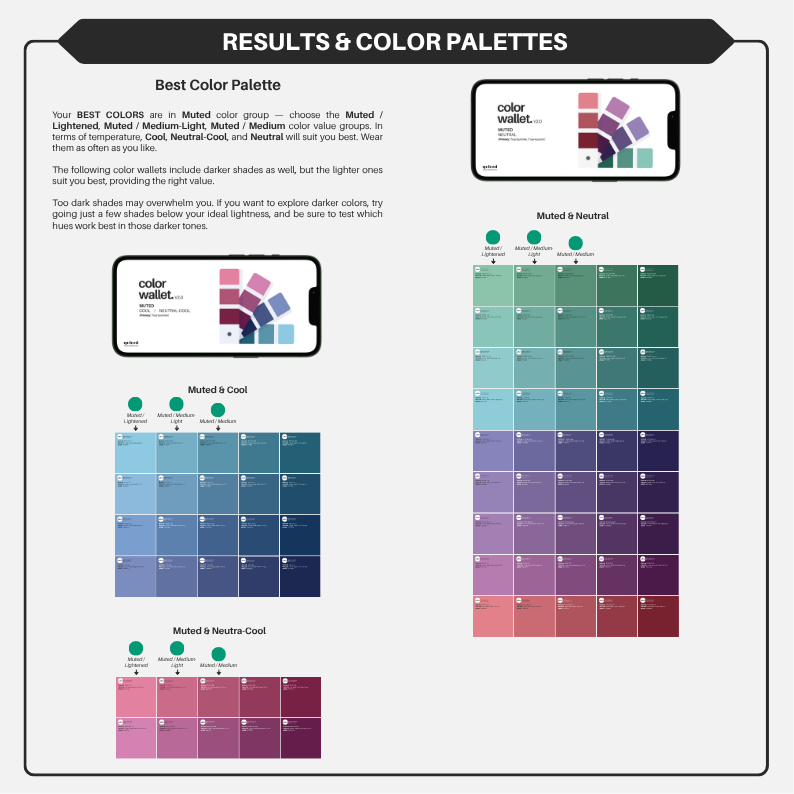
Part 9
Results and Color Palettes — organized, labeled, and ready to be explored
I won’t give you 30 or 40 hand-picked colors. While some people want a custom selection, I found those systems limiting. What I missed in most color analysis methods was a clear structure and freedom to choose. That’s what I aim to offer you—an understanding of how colors work, where they sit on the color wheel, and how to interact with them.
When you shop and see a new color, you shouldn’t have to guess by holding up a palette. Instead, if you understand your best lightness, chroma, and hue, you’ll know whether a tone is ideal, close, or off. That’s the goal of the palette and results pages: to combine your test results so you can explore what works best for you.
Exclusive Virtual Draping in 900+ Hoodie Colors — Explore the Full Color Wheel
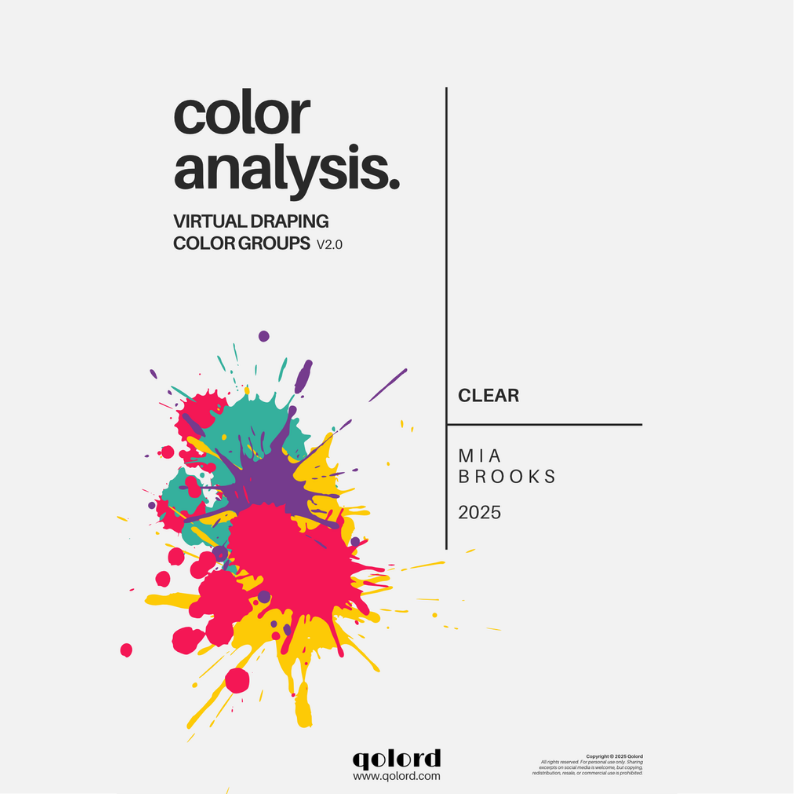
Online Color Analysis often feels mysterious or vague — filters, unrealistic RGB swatches, and palettes that don’t explain themselves. These Hoodie Ebooks give you a visual experience of 900+ colors draped virtually near your face. It’s not just a palette — it’s a journey of discovering how different colors look on you, side by side, in context.
Why Just Guess, When You Can See?
Comparison is the only real way to see what flatters and what distorts. You’ll see hundreds of colors draped on you, grouped by clear structure.
The colors are organized by both Qolord color groups and 48 hues, so you can clearly see the difference between light vs. dark, bright vs. muted, heavy vs. soft. Every color name and group is labeled, with clickable links to shop the exact hoodie colors or groups directly in the Qolord store.
You finally get to see where you belong on the color wheel. You don’t have to believe anyone — now, you can actually see. You don’t just get answers — you get tools to learn yourself.
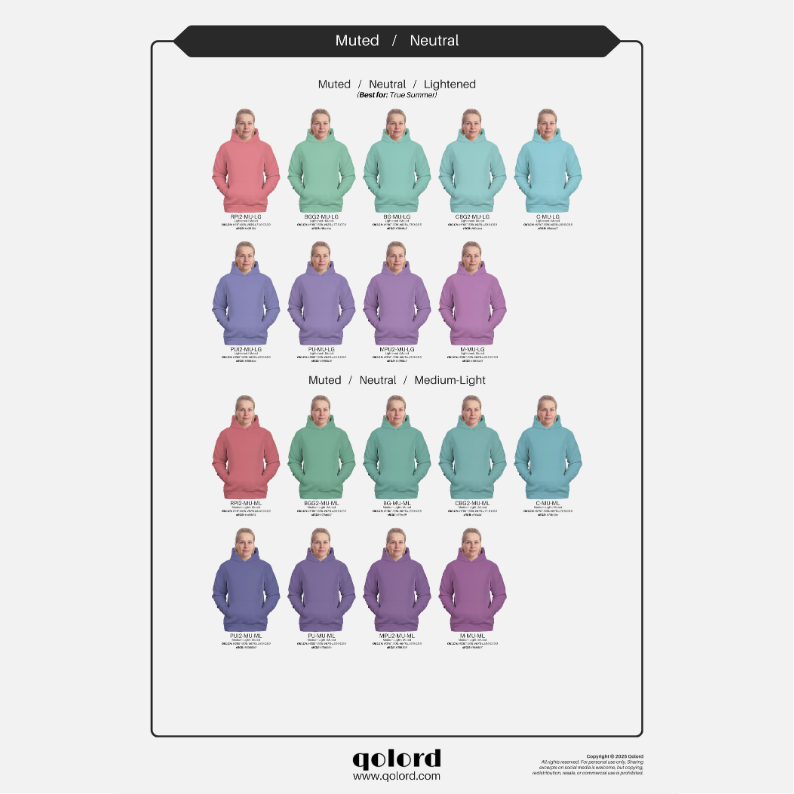
The Hoodie Ebooks by Color Groups: See All Your Best Colors in One Place
The Hoodie Ebooks (Color Group version) show your virtual draping results organized into 5 Qolord groups: Clear, Medium, Muted, Fully-Muted, and Neutral. Each ebook displays warm, neutral-warm, neutral, neutral-cool, and cool tones across every group—so you can compare colors that share similar characteristics.
Your best group will be marked from your online color analysis, but you’ll have the full view to explore nearby options too.
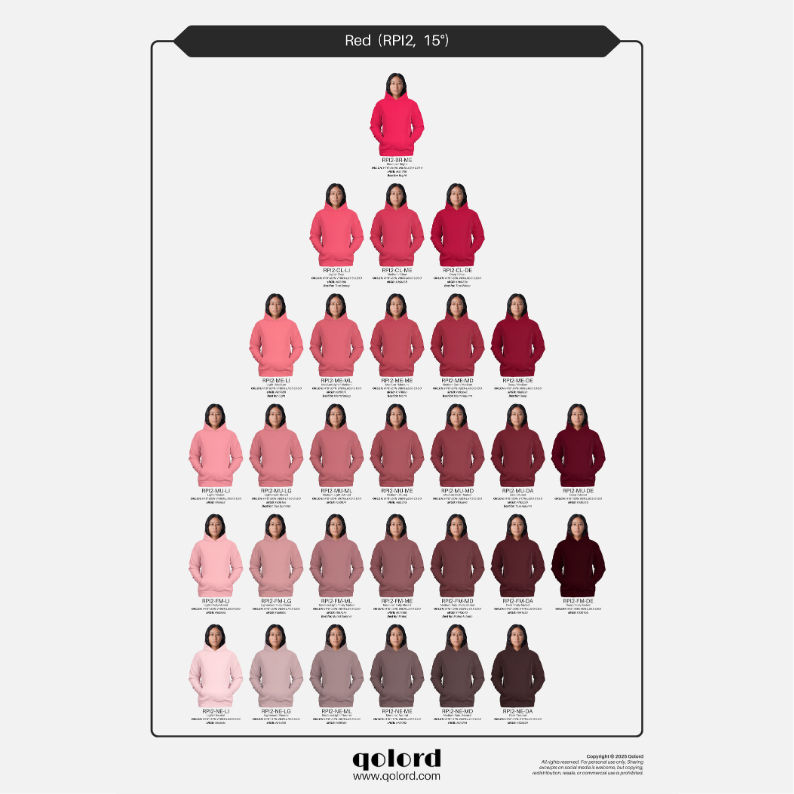
The Hue Hoodie Ebook: One Color Family at a Time
The Hoodie Ebook (Hue version) shows your virtual draping results in all 48 hues of the full Qolord color system—covering the entire color wheel. Each page includes grouped hoodie images by hue, lightness and chroma.
Each page gives you one hue at a time — all shades and variations laid out to compare. You’ll see where colors become too strong, too dull, too heavy, or just right. It’s a hands-on tool that puts the power in your hands. No more decoding vague palettes. You’ll explore yourself what feels like you.
Real People, Real Transformation
These are stories from people who’ve been through Qolord's process — curious, unsure, sometimes skeptical. But something clicked when they saw themselves in the right colors. Not a dramatic makeover, just a quiet shift that made things make sense.
Your Journey Starts Here. Ready?
Now you’ve seen what the Qolord's online color analysis system offers, how it works, and how deeply it can help you understand yourself through color.
Now it’s your turn. If it sparked something in you—curiosity, clarity, maybe even relief—you’re ready to begin. Below you’ll find a simple step-by-step guide on how to receive your analysis, and a comparison table to help you choose the option that fits you best.
The Process of Receiving Your Color Analysis
-
STEP 1: Choose your color analysis type and make the purchase
When you select a product (online color analysis, hoodie ebooks or a bundle of both), it will be added to your cart. Head to checkout, enter your billing information, choose your payment method, and complete your purchase.
-
STEP 2: Learn about the photo guidelines
Review guidelinesYou'll need to submit specific photos for online color analysis and hoodie ebooks. Please review the necessary guidelines.
-
STEP 3: Fill out the form
Fill out the formVisit the link below to complete the form you reviewed earlier, and submit your answers and photos.
-
STEP 4: Receive a confirmation email
Your submission will be reviewed within 5 business days. If I'll need any additional information, you'll receive an email with further questions. If everything checks out, you'll receive a confirmation email.
-
STEP 5: Receive your color analysis PDFs
Within 2 weeks after confirmation email, you’ll get an email with a download link to a ZIP file. It will include your Color Analysis Report, Hoodie Ebooks, or both. The link will stay active for 1 week.
| Hoodie E-Books | Online Color Analysis | Bundle: Online Color Analysis + Hoodie Ebooks | |
|---|---|---|---|
| White Balanced Photo | ✔ | ✔ | ✔ |
| Personalized comments | ✔ | ✔ | |
| 5 Hoodie Ebooks (color groups) | ✔ | ✔ | |
| 1 Hoodie Ebook (hues) | ✔ | ✔ | |
| Skin Tone Test | ✔ | ✔ | |
| Intensity Test | ✔ | ✔ | |
| Value Test | ✔ | ✔ | |
| Absolute Value Test | ✔ | ✔ | |
| Temperature Test | ✔ | ✔ | |
| Seasonal Comparison Test | ✔ | ✔ | |
| Closest Color Comparison Test | ✔ | ✔ | |
| Color Analysis Results | ✔ | ✔ | |
| Best Color Palette | ✔ | ✔ | |
| Neutral Color Palette | ✔ | ✔ |
FAQ: Thoughtful Answers
If anything feels unclear or you’re unsure whether this is the right fit, you’re always welcome to send a message. I’ve gathered the most common questions people ask. It’s here to help you feel informed.
Collapsible content
Do I get a Color Analysis Report and Hoodie Ebooks with this service?
Yes, if you purchase the Color Analysis Bundle, you’ll receive both the Personal Color Analysis Report and the Virtual Draping – 6 Personalized Hoodie Ebooks. If you purchase only the Report or only the Ebooks, you'll receive just that part.
The Bundle includes everything, so if you'd like the full experience—both the in-depth report and the hoodie visuals—go for the bundle. You can select your preferred option at the top of the page by choosing the product that fits you best.
How long does a colour analysis take?
Color analysis results are usually delivered within 2 weeks after your photos and form are confirmed. The review process begins once your submission is checked—this may take up to 5 business days. If your photos need to be adjusted or retaken, no worries—once the updated ones are received, the 2-week analysis period will start from that point.
How will I receive my color analysis?
Your color analysis will be delivered as PDF files. Once it’s ready, you’ll receive an email with a link to download a ZIP archive containing all your files—your Color Analysis Report, 6 Hoodie Ebooks or both.
After downloading, simply unzip the file to access everything. The download link will stay active for 7 days, so be sure to save your files in time. If you miss the window, just let me know—I’ll happily reactivate the link for you.
What to do before color analysis?
Before a color analysis, prepare by removing any makeup and washing your face to reveal your natural skin tone. Wear neutral, matte clothing or drape a neutral-colored cloth around your shoulders to avoid color reflections. Find a well-lit space with natural light, avoiding direct sunlight or harsh artificial lighting. Have your hair pulled back from your face to clearly show your features. These steps help ensure accurate assessment of your true coloring.
What if my photos aren’t perfect?
If your images don’t follow the strict 😊 photo guidelines, I’ll ask you to retake them—but don’t worry, I’ll guide you clearly. These rules exist for a reason: I want to give you the most accurate and high-quality results possible, not something halfway done.
Photos that aren’t straight or well-lit often need extra editing to align your face correctly for the hoodie previews. That takes quite a bit of time, so I truly appreciate when you send clear, properly angled images from the start.
If anything’s missing or off, I’ll let you know and wait for an updated photo. Just keep in mind—your 2-week delivery time starts only after I confirm your final image, so any delays in sending the right photos will push back your result timeline.
The RAW images are too large to upload—what should I do?
No problem at all. If you can’t attach them via the form due to size, simply upload them to an online file server like Google Drive, WeTransfer, or any other platform you prefer. Then just paste the download link into the form.
I’ll download your images from there and confirm in my reply that I’ve received them. After that, you’re free to take the files down from your storage.
Is this analysis suitable for people of color?
Absolutely—yes, 100%. This color analysis system works for everyone with skin, regardless of ethnicity or background. It’s not based on rigid or outdated beauty standards, but on real-time interaction between your unique skin tone and color.
The process is fully custom and individual, focused on observing how your skin reacts to different colors—not on assumptions, stereotypes, or predefined categories. I look at you, not a rulebook.
My goal is to offer an experience that is respectful, inclusive, and empowering. Supporting all people in discovering their best colors—without bias or limitation—is at the heart of this work.
Do you consider hair and eye color in your color analysis?
Not directly. I don’t determine your color group or season based on your hair or eye color—having black hair doesn’t automatically mean Winter, for example. That said, your best colors will naturally enhance your hair and eyes, making them stand out more.
There are often patterns—like darker hair aligning with deeper seasons—but relying on hair and eye color alone is an outdated method that has led to many misclassifications. Testing skin reactions to color is much more precise.
What does contrast in the face mean?
Contrast in the face refers to the difference in lightness and darkness between your facial features—like skin, hair, eyes, and brows. Some color analysis methods use this to suggest how much contrast your clothing should have to feel balanced. For example, someone with high contrast (very light skin and very dark hair) often looks best in bold, high-contrast outfits, while someone with low contrast tends to suit softer combinations.
Some systems test this by comparing the contrast between all features, while others (like Qolord) focus more on analyzing colors directly against isolated skin to find best colors. This helps reveal subtle changes more clearly and avoids confusion caused by surrounding features.
Still, understanding your natural contrast is helpful when deciding how much contrast you can wear in an outfit—whether you suit strong light-dark combinations or more blended, smooth transitions.
Will I get a color palette with my results?
Yes, your results will include a color group palette showing your best colors across key color dimensions. It will highlight the most flattering tones for you, based on your unique analysis. You can also purchase optional digital color wallets—compact, easy-to-use guides designed to help you shop and compare colors effortlessly.
Do you include recommendations for makeup, hair color, jewelry, gemstones, or color combinations?
Not at the moment, but I may add them in the future. If this is something you really miss, feel free to let me know—your feedback helps me improve the service.
In general:
- Jewelry: if you're warm, wear gold; if you're cool, wear silver. If you're neutral, you can usually wear both, depending on whether on how far you lean warm or cool.
- Makeup: go for shades within your palette. If you're muted, stick to muted makeup tones; if you're bright, choose clearer, more vibrant colors, and so on.
- Hair color: your natural shade is always the best. If coloring, stay within two tones of your natural hair, no further. If you have gray hair, you can color it back to your younger natural color.
- Gemstones: pick those that reflect your palette colors.
- Color combinations: a fascinating topic, but not yet included.
I’m always open to adding more if it’s truly useful.
Is personal color analysis worth it?
Yes—if you want to look more harmonious, shop with more ease, and understand what enhances your natural features. A good color analysis gives clarity on what works, what doesn’t, and why—saving you time, money, and guesswork.
It’s also a unique and fun experience to see yourself in over 900+ color tones and have this material for life to explore, learn from, and return to anytime.
Is color analysis a science?
Color analysis is not a science. Science means having a clearly defined, controlled method with repeatable results that can be reviewed by experts. Some color analysts claim their systems are scientific, but what they do is usually apply scientific concepts—like color properties such as hue, chroma, and lightness—rather than using a strictly scientific testing process. The methodology itself is more experiential and based on observation, not controlled experiments.
Two important factors affect color analysis: first, color perception varies between people because the brain processes sensory input uniquely, influenced by personal experiences, often formed in childhood. Second, the sense of harmony with colors differs due to cultural background and individual preference, similar to how people respond differently to art or interior design styles. One person might prefer a sleek Swedish minimalistic kitchen, while another favors a warm, rustic farmhouse style—both are valid harmonies but different.
Similarly, in color analysis, Sci/Art-based approaches focus mainly on skin harmony, yet I’ve noticed they sometimes wear colors brighter than what I would call harmony. On the other hand, systems like Image International Institute avoid such bright colors and emphasize right intensity more. Qolord is designed to find your core best color that fits all color properties, and how far you choose to stray from that is up to you. Wearing slightly brighter, darker, or more muted colors than your ideal is fine, but they won’t be as perfectly aligned. Other color analysis schools may include a wider range of colors in their palettes, often without focusing as much on explaining how closely each one aligns with your best match.
How to find what colors look best on you?
The process starts with testing intensity—whether leaning bright, muted, or medium—which establishes a foundation for understanding color characteristics. Next, the ideal lightness range is explored to determine if lighter, deeper, or balanced shades suit best. Finally, temperature—warm, cool, or neutral—is assessed to identify which hues harmonize with unique features.
Instead of fixed palettes, this method provides a clear structure and freedom to recognize and choose colors in real life, helping to understand and apply color characteristics that enhance natural harmony.
Are online color analyses accurate?
Online color analysis can be accurate if the system is well-designed and takes into account real-world lighting, color relationships, and skin tone variations. Many quick or AI-generated tests tend to oversimplify and rely on filters or poor-quality images, leading to inconsistent results.
At Qolord, accuracy is prioritized through a structured, multi-step process that tests chroma, value, and temperature using visual comparisons with your actual white-balanced face—not just software guesses. While in-person analysis can provide more context, Qolord’s method is designed to offer a deeply personalized and educational experience that helps you understand how color works and which color characteristics you naturally lean toward.
Can color analysis be done online?
Yes, color analysis can be done online using high-quality photos, structured testing, and detailed comparisons. This system tests your coloring through a series of comparisons with color rectangles and virtually draped hoodies, gradually identifying your best intensity, lightness, temperature, and hues.
You’ll receive full palettes to explore and apply in real life, helping you understand how color works and which tones truly suit you. However, most online apps and filters are not precise for many reasons, so having an analyst guide you remains valuable for a deeper, more accurate virtual color understanding.
How much does a personal color analysis cost?
Prices vary widely depending on the method and analyst. In-person sessions can range from $150 to $1000. Online color analyses are often more affordable, starting around $80, but can go up to $1000, but quality and depth differ.
This one offers many color tests and virtual draping with over 900 colors, detailed explanations, and a downloadable PDF with all your results—making it a one-time investment into understanding your colors in depth for you to revisit anytime.
Can I get a refund?
No, refunds are not available. Each analysis requires many hours of personalized work and is a custom digital product, so all sales are final.
I don’t agree with my results. What should I do?
This hasn’t happened in my experience yet, but it can happen sometimes. Please contact me and share your concerns. I will review the analysis again, check if the photos might be the issue, and explain my perspective. If needed, we can test with new real-life photos. I’m happy to assist and correct any mistakes. It’s important to reach out instead of feeling disappointed—there’s always a reason behind your feelings and the results, and together we’ll get to the bottom of it.
Is a call or live consultation included after the color analysis?
No, live calls or consultations are not included. However, you're always welcome to reach out through any of the online channels I’m active on—website, email, TikTok, Instagram, Facebook, YouTube, or Reddit. I’m happy to receive your questions or feedback and will do my best to respond as soon as I can. Feel free to connect anytime.
Do you have a color analysis certification?
No, I don’t have formal certification. I’m a self-learner who has deeply explored color analysis by combining research, coding, and real-life observation. My goal isn’t to create a completely new system, but to connect the dots between existing ones, making them more visual, clear, and structured while clearing up the common confusions I’ve noticed.
I’m a firm believer that everyone has the agency to learn, decide, create, and express their own way. That’s why I don’t present myself as a know-it-all analyst with the only “right” method. Instead, I see myself more as a guide, offering you tools and knowledge so you can develop your own personal relationship with color and explore it freely.
If you’re specifically looking for a certified specialist from certain schools, I might not be the one. But if my system resonates with you, welcome aboard—I’m excited to guide you on this journey. 😊
Will Eve always be the one doing my color analysis?
Yes, currently I am the only one practicing this method (in the world 🤓). I will personally review your coloring, analyze your colors, add personalized comments, and do my best to make you feel confident and supported throughout your color journey. 😊